Own-Brand Supply · India
Private label egg powder & contract supply
How own-brand egg ingredient programmes work — base product, packaging, documentation and label responsibility — and how to evaluate an Indian manufacturer for private-label supply. Sahya Agro discusses private-label supply from its standard product range; specific capabilities are confirmed per discussion, never assumed.
Quick answer
What is private-label egg powder supply? A manufacturer produces egg powder that ships under your brand — you own the label and the customer; the manufacturer owns production and the underlying specification. Sahya Agro is an Indian egg-ingredient manufacturer open to private-label and contract-supply discussions built on its standard range (whole egg, egg white, egg yolk powders and liquid egg). Capabilities, pack formats and terms: [TO BE CONFIRMED] per enquiry — this page explains the model honestly rather than advertising an unverified service list.
The private-label model in egg ingredients
Industry practice: private-label supply splits the value chain between two parties. The manufacturer runs the plant — breaking, pasteurisation, spray drying, packing — and stands behind the specification and batch documentation. The buyer owns the brand: the printed bag or carton, the label claims, the pricing to their market and the customer relationship. The product inside is the manufacturer's standard, documented ingredient; the identity outside is the buyer's.
This model exists because spray-drying capacity is capital-intensive and quality-critical, while distribution is relationship-intensive. Few distributors want to build a dryer; few manufacturers want to own every national market. Private label lets each side do the half it is good at.
Contract supply is the close cousin: the same base product and documentation, usually under plainer terms — buyer-specific pack formats, volumes or delivery schedules agreed per contract, sometimes with the manufacturer's own label, sometimes unprinted.
What private label is not
It is not a different product. A private-label bag of whole egg powder succeeds or fails on exactly the same things as a manufacturer's own-brand bag: the specification, the COA history, the functional performance in the customer's application. Any programme conversation that starts with artwork before specifications is running in the wrong order.
Who buys private-label egg ingredients
- Ingredient distributors building a house brand for their national food-manufacturing customers — the most common private-label buyer in this category.
- Importers supplying bakeries, sauce producers and processors in markets like the Gulf, South Asia and beyond, where a consistent own-label line simplifies repeat business. (Market context: export supply from India.)
- Retail and food-service chains with own-label programmes extending into ingredients and bakery supplies.
- Food brands that want a documented egg ingredient inside their own packaging ecosystem without investing in manufacturing.
What unites them: each needs a verified base product — real specifications, batch-matched COAs and traceability — because their brand inherits whatever the manufacturer actually produces. That is why the evaluation step below matters more than the commercial one.
The parts of a private-label programme
Industry practice — the elements a complete programme agreement usually covers:
- Base product selection. Which documented product carries your brand — for egg ingredients, typically whole egg powder for general bakery lines, egg white powder where protein or whipping leads, egg yolk powder for emulsification-led ranges. Our comparison page maps the differences.
- Specification alignment. The manufacturer's specification becomes your product's specification. Any deviation (functional grade, parameter windows) is a separate technical conversation, confirmed in writing — never assumed.
- Pack format. Bag or carton type, net weights, liner specification, pallet pattern — matched to your customers' handling reality.
- Label and print. Artwork, mandatory declarations for the destination market, batch coding and production-date marking. Regulatory responsibility for label content sits with the brand owner; the manufacturer supplies the documentation those declarations rest on.
- Documentation flow. Specification, batch COAs, and — for export programmes — shipping documents per order. See what a COA should contain.
- Commercial terms. Volumes, schedules, pricing and payment — quoted per programme: [PRICING ON REQUEST], [ACTUAL MOQ].
Packaging for private-label egg powder
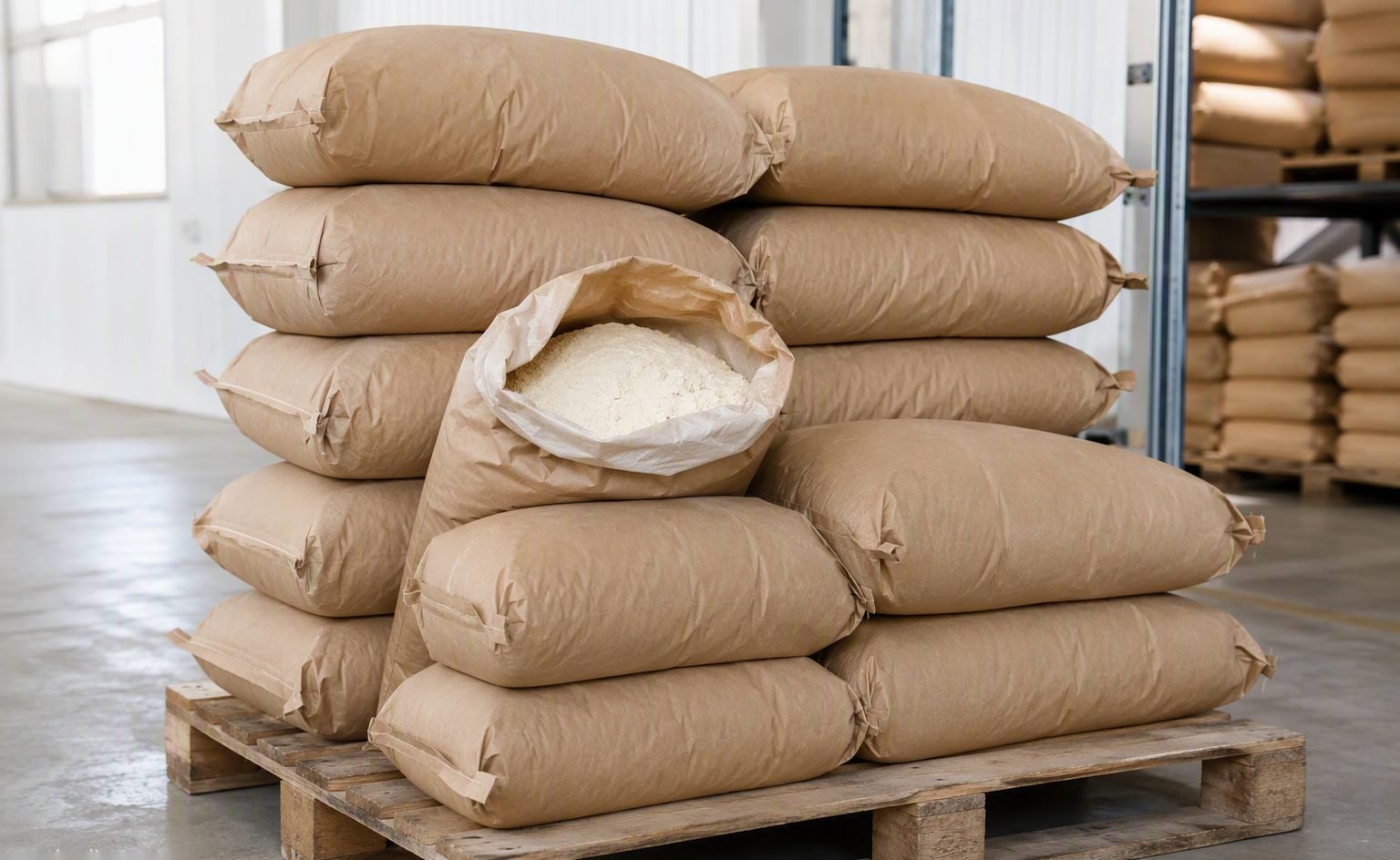
Industry practice: bulk egg powder commonly ships in multi-wall paper bags with food-grade inner liners (typical industry net weights range from around 5kg to 25kg), cartons with inliners, and big bags for industrial volumes; retail or food-service pack sizes appear in some programmes. Whatever the format, three things protect the product: a moisture-tight liner, oxygen management and outer packaging that survives the warehouse chain — the details live in our packaging & storage overview and the packaging guide.
For a private-label programme the label adds a fourth requirement: print that carries your brand and the batch code legibly, because the batch code is the thread that ties your customer's complaint back to the manufacturer's production record. Sahya Agro-specific pack formats and print capabilities: [PACKAGING TO BE CONFIRMED] — confirmed during programme discussion, not advertised in advance.
How to evaluate a private-label manufacturer
Your brand inherits the manufacturer's process, so evaluate the manufacturer first and the packaging second:
- Specification and COA history — a sequence of batch COAs, not one sample document. Trend, not snapshot.
- Certification verification — verify FSSAI and any claimed schemes with their issuers. Where Sahya Agro documentation is still being finalised, we say so: [CERTIFICATION TO BE CONFIRMED], [FSSAI LICENCE NO. — TBC].
- Application testing — your customers will judge your brand on performance; test the base product in the applications you intend to serve before committing artwork. Request evaluation samples.
- Pack-format confirmation — formats, liner spec, print lead times and minimum runs, in writing.
- Live traceability check — ask the manufacturer to retrieve production and testing records for a real batch while you watch. Our traceability model shows the expected chain.
The full five-lens method is in how to evaluate egg powder suppliers.
Sahya Agro's position — stated plainly
Sahya Agro-specific detail: [TO BE CONFIRMED] in all commercial particulars. What can be stated today:
- We are an Indian egg and egg-ingredient manufacturer based in Haryana, producing a standard range of spray-dried egg powders and pasteurised liquid egg products — the natural base products for an own-label programme.
- Private-label and contract-supply discussions are open with qualified B2B buyers, domestic and international.
- Buying ingredient for your own production rather than your own brand? That is bulk egg powder supply.
- What we will not do is publish an invented service menu: pack formats, print capabilities, minimum runs and programme terms are confirmed per discussion — [TO BE CONFIRMED].
- Every programme, whatever the label, runs on the same foundation as our standard supply: written specifications, batch-matched documentation and evaluation samples before volume commitments.
From enquiry to own-brand supply
- Programme enquiry — tell us the base product, your market, estimated volumes and pack-format needs through the quote request (mention private label in the message).
- Specification exchange — review the base product specification against your customers' requirements.
- Sampling and validation — evaluation samples tested in your target applications.
- Programme terms — pack formats, label/print process, volumes, schedules and pricing confirmed in writing: [TO BE CONFIRMED].
- First production run — shipped with batch-matched COA and programme documentation.
- Recurring supply — planned cycles with the same specification governing every batch.
For market-specific import requirements — documentation, destination rules, logistics — see the export section and the import–export guide.
Answers
Private-label egg powder — frequently asked questions
Private-label supply means a manufacturer produces egg powder that is packed and shipped under the buyer's own brand — the buyer owns the label, the brand and the customer relationship; the manufacturer owns production and the underlying specification. It is standard practice across food ingredients and lets importers, distributors and food brands sell a documented product without owning a drying plant.
Private-label and contract-supply discussions are open with qualified B2B buyers, using the standard Sahya Agro product range as the base. Specific capabilities — pack formats, printing, volumes and terms — are confirmed per discussion: [TO BE CONFIRMED]. Nothing on this page should be read as a confirmed service list; the page explains the model and how to start the conversation.
Ingredient distributors building their own brand, importers supplying national food industries, retail and food-service chains with own-label programmes, and food brands that want a documented egg ingredient without investing in manufacturing. Each buyer type needs the same foundation: a verified base product with real specifications and batch documentation.
Industry practice for bulk egg powder includes multi-wall paper bags with food-grade liners, cartons with inliners, and larger formats such as big bags for industrial volumes — with retail or food-service pack sizes possible in some programmes. Sahya Agro's available formats for private-label supply: [PACKAGING TO BE CONFIRMED].
The brand owner. The manufacturer supplies the specification, COA and production documentation; the buyer's label — nutrition panel, claims, regulatory declarations for the destination market — is the buyer's legal responsibility. A serious manufacturer supports this with accurate documentation; a serious buyer verifies it before printing.
Exactly as you would evaluate any ingredient supplier, plus packaging-specific checks: verify the specification and COA history, verify certifications with issuers, test samples in your application, confirm pack-format capability and print/label lead times, and ask for a live batch-record retrieval. The evaluation method is published in our supplier-qualification guide.
Start the conversation
Build your brand on a documented ingredient
Tell us the base product, target market and pack format you have in mind — we respond with specifications, documentation and an honest capability assessment.
Questions before you brief us? info@sahyaeggpowder.com · +91 8950846072 · WhatsApp