Food Safety in Egg Ingredients
Hygiene, pasteurisation, contamination control and monitoring for egg-derived ingredients — what the controls are, why they exist, and what to ask any supplier to document.
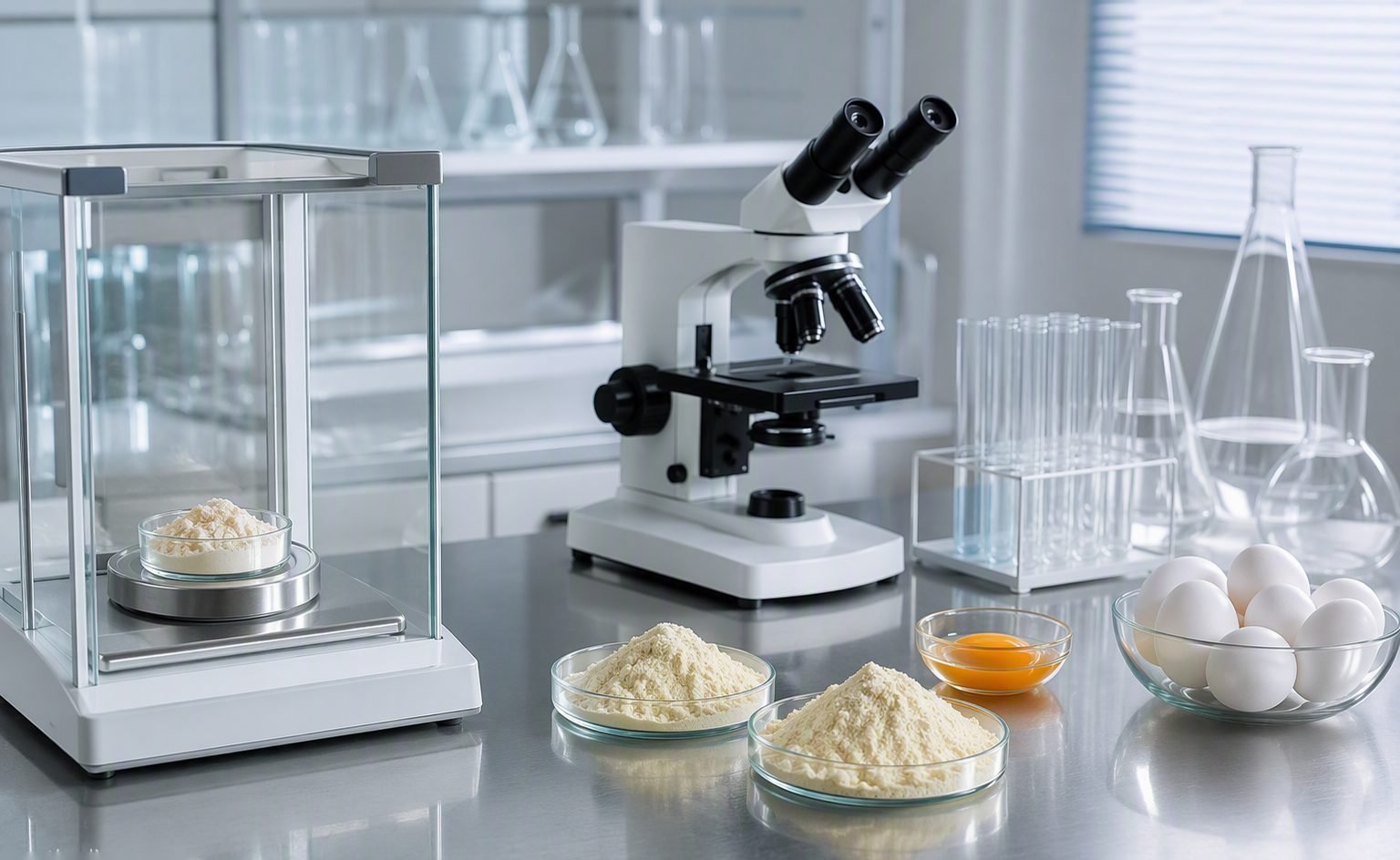
Food safety for egg-derived ingredients: the buyer's map
Egg is a high-value, pathogen-sensitive raw material. The same protein richness that makes it functionally irreplaceable also makes it an excellent growth medium — which is why food-safety control is the first thing your QA team should examine in any egg-ingredient supplier, and why this page explains the control landscape before it mentions us. The concepts here are industry-standard; where a specific Sahya Agro parameter is involved, it is marked [PROCESS PARAMETER TO BE CONFIRMED] rather than invented.
One rule governs everything below: no absolute claims. You will not read "pathogen-free", "zero contamination" or "guaranteed safe" here, because no honest food manufacturer says those things. What a serious supplier offers is validated controls, monitoring, batch testing and documentation — verification against agreed specifications, not slogans.
Raw material hygiene & egg handling
Control starts before the factory door: shell eggs from approved sources, transported and held under hygienic conditions, inspected at receipt, and moved promptly into processing. Cracked, dirty or temperature-abused eggs are a contamination vector that no downstream step fully repairs, so incoming discipline — supplier approval, receipt checks, hygienic storage and first-in-first-out rotation — is the foundation everything else sits on.
Breaking and liquid handling are the highest-risk stages of the process: raw egg is exposed, equipment is wet, and the environment must be managed to keep organism load low before the kill step. Zoning, cleaning regimes and time-temperature control of liquid egg are the classic levers here. Our specific incoming and handling controls are [TO BE CONFIRMED] and publish with verified documentation.
Processing controls & the pasteurisation concept
Pasteurisation is the designed kill step: a validated combination of temperature and time that reduces vegetative pathogens — Salmonella being the organism of concern in egg — to safe levels while preserving functionality. Different egg components need different treatments because fat, sugar and salt change heat resistance; yolk, whole egg and albumen each have their own requirements. We deliberately publish no temperatures or times: those belong in verified process documentation, and ours appear as [PROCESS PARAMETER TO BE CONFIRMED] until confirmed.
Drying
Spray drying converts pasteurised liquid egg into powder by atomising it into hot air. Drying is not a second kill step to rely on — its job is water removal — so hygienic design of the dryer, air handling and powder side of the plant matters. Moisture control at this stage determines both stability and the powder's physical quality; target values are specification parameters, [SPECIFICATION TO BE CONFIRMED].
Contamination control after the kill step
The defining principle of egg-plant hygiene is the raw/cooked divide — here, the raw/pasteurised divide. Everything after pasteurisation is treated as high-hygiene: separated air, dedicated equipment, controlled personnel flow, positive pressure where applicable, and cleaning regimes matched to dry-plant realities (dry cleaning and controlled wet cleaning, since water in a powder plant is itself a risk). Recontamination after the kill step is the failure mode every control exists to prevent.
Microbiological monitoring
Two layers work together: environmental monitoring — swab programmes on post-process surfaces and zones verifying that hygiene controls hold — and product testing — batch-level analysis against the specification's microbiological criteria before release. Indicator organisms verify process hygiene; pathogen testing verifies the safety outcome. Panels and limits are specification content: [TO BE CONFIRMED]. See the testing guide for the buyer-side view.
Environmental & packaging hygiene
Packaging is a food-contact surface: food-grade materials, hygienic storage of packaging stock, clean filling operations and intact, verified seals. A perfect powder in a compromised bag is a compromised product. Pack formats and materials are [PACKAGING TO BE CONFIRMED]; the packaging & storage guide covers integrity in detail.
Storage & transport
Food-safety control extends past the factory gate: dry, cool storage; clean, dry, odour-free transport; and containers inspected before loading. Powder's ambient stability is an advantage only while the pack stays sealed and dry. Specific storage and transport conditions publish with the technical data sheet [SPECIFICATION TO BE CONFIRMED].
What to ask any egg supplier
- How is pasteurisation validated, and is validation documentation available for review?
- How are raw and post-process zones separated — physically and in personnel/material flow?
- What does the environmental monitoring programme cover, and how are findings handled?
- What microbiological criteria apply to each batch, and where are they stated?
- How are packaging materials controlled and seals verified?
- What happens when a batch or swab result is out of limit — who decides, and how is it documented?
Where Sahya Agro stands today
We describe our food-safety approach at concept level because verified parameters are still being confirmed for publication. What we commit to openly:
- Pasteurised products with batch-level documentation.
- Specifications and COAs shared during qualification.
- No absolute safety claims, ever — controls and records instead.
Exact process parameters [PROCESS PARAMETER TO BE CONFIRMED]; microbiological limits [TO BE CONFIRMED]; certifications [CERTIFICATION STATUS TO BE CONFIRMED]. When verified documents publish, placeholders on this page are replaced with the real values — not before.
Food safety questions
Egg powder produced under validated pasteurisation, hygienic post-process control and batch microbiological testing is a well-established, safe industrial ingredient used worldwide. Safety is delivered by those controls and verified per batch against specification criteria — not by absolute claims, which no responsible supplier makes.
A validated heat treatment — a controlled temperature applied for a defined time — that reduces vegetative pathogens such as Salmonella to safe levels while preserving the egg's functional properties. Whole egg, yolk and albumen each require different treatment conditions. Exact parameters belong in verified process documentation [PROCESS PARAMETER TO BE CONFIRMED].
No — drying removes water; it is not a sterilisation step and should not be relied on as one. Microbiological safety comes from the validated pasteurisation before drying and from hygienic control of everything after it. 'Sterile' is not a claim any honest supplier makes about food ingredients.
Recontamination after the kill step: once egg is pasteurised, contact with raw-zone equipment, personnel, air or moisture can undo the lethality step. That is why serious plants physically separate raw and post-process zones and run environmental monitoring to verify the separation holds.
Pathogen testing relevant to egg products — Salmonella is the organism of concern — plus indicator-organism testing as hygiene verification. Exact panels and limits belong in the agreed specification; ours publish when verified [TO BE CONFIRMED].
Ask for pasteurisation validation documentation, the environmental monitoring approach, batch microbiological criteria, and evidence of raw/post-process zoning — then verify through questionnaires, document review and, where volumes justify, audit. A supplier's willingness to be evaluated is itself a data point.
We publish no certification we cannot evidence. ISO 22000, HACCP, BRCGS, IFS and similar schemes are all [CERTIFICATION STATUS TO BE CONFIRMED] until verified certificates publish. FSSAI licensing — an Indian statutory registration, distinct from third-party certification — is [FSSAI LICENCE NO. — TBC].
Yes — once rehydrated, treat it with the same food-safety discipline as liquid egg: keep it chilled, use it promptly, and never leave it at ambient temperature. Powder's stability advantage ends the moment water is added.
Dry, cool and sealed; moisture pickup is the main enemy of both safety and quality. Exact storage conditions and shelf-life values publish with the technical data sheet [SPECIFICATION TO BE CONFIRMED]. Reseal opened packs promptly.
Reviewing supplier food safety?
Ask for our documentation — specification, batch records and samples — and evaluate us the way this guide describes.