Egg Ingredients for Confectionery Manufacturers
Nougat that holds its density, marshmallow that sets, fillings that stay smooth — aerated and emulsified confectionery runs on egg functionality. Here is what that means for your ingredient sourcing.
The confectionery industry's ingredient reality
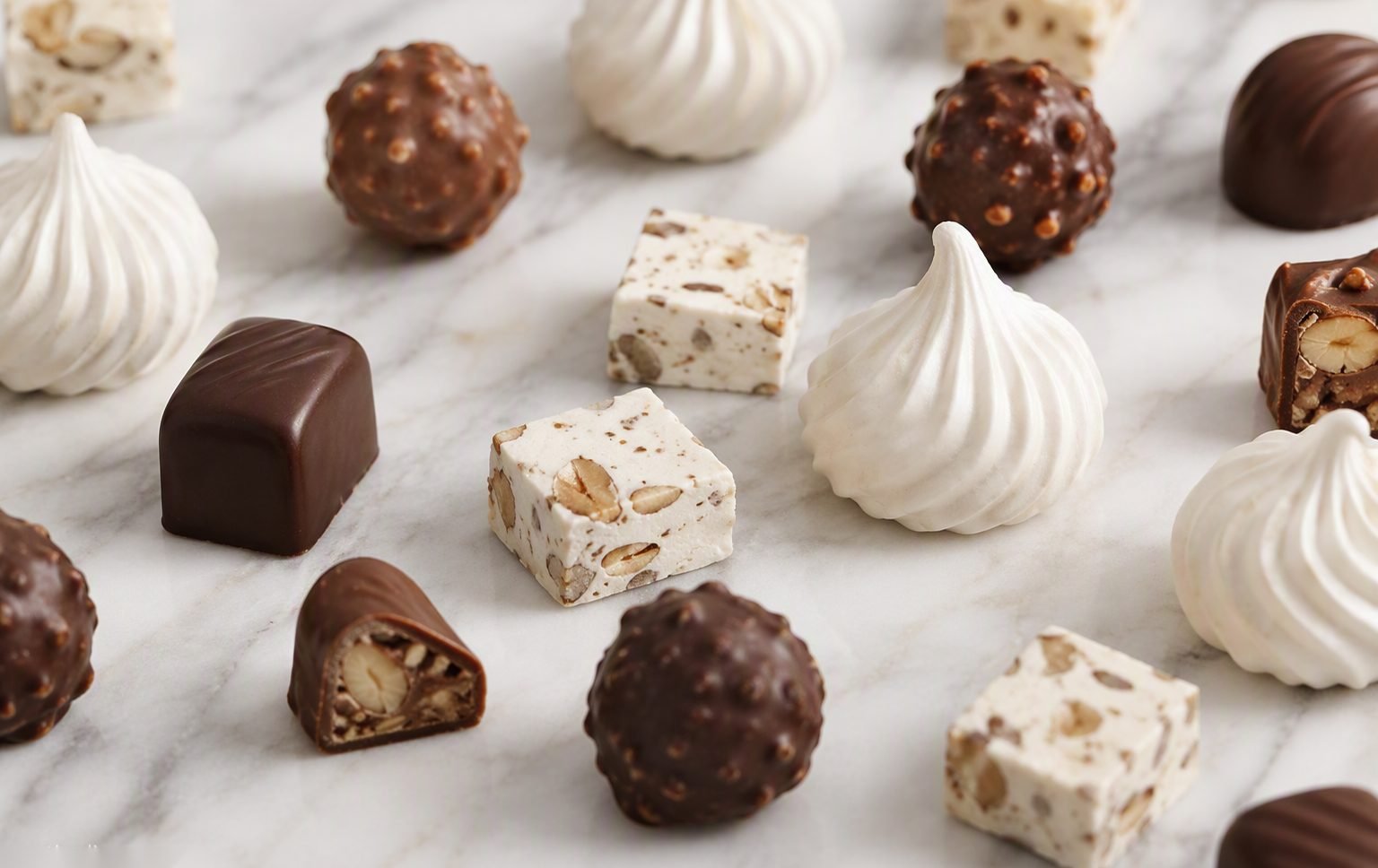
Confectionery is a category of extremes: products defined by air (nougat, marshmallow, meringue-type sweets) and products defined by richness (praline centres, fudge, custard fillings) sit side by side in the same plant. Egg serves both ends of that spectrum — albumen for aeration, yolk for emulsification and richness — but it does not serve everything in between, and honest guidance matters here: many confectionery categories use no egg at all.
Where egg is used, it is usually load-bearing. An aerated sweet is a stabilised foam; a custard filling is an emulsion. That makes ingredient consistency unusually consequential: a whipping agent that varies by ten percent shows up as nougat that cuts differently, marshmallow that sets differently, and product that misses its density spec. This is the context in which confectionery buyers evaluate egg ingredients — and why dried albumen has been a confectionery staple for generations.
From Industry Requirement to RFQ
1 · Industry requirement
Typical need: aeration, whipping and binding in confectionery systems. Define your process conditions, volumes and destination before selecting an ingredient.
2 · Relevant egg ingredients
Potentially relevant ingredients for evaluation: Egg White Powder, Whole Egg Powder, Egg Yolk Powder. Final selection depends on formulation, process and customer requirements.
3 · Technical information
Review the buyer specification summary and the specification guide; product specifications are provided per product on request.
4 · RFQ
Share your requirement, destination and documentation needs through the RFQ form — or request a sample first.
Where egg ingredients fit in confectionery
The physics of aerated confectionery is demanding: whip a protein solution into foam, then hit it with sugar syrup hot enough to cook the proteins into a stable network — without collapsing the air structure you just built. Albumen is one of the few food proteins that takes this punishment gracefully, which is why nougat and marshmallow recipes have relied on egg white for well over a century and why alternatives are usually benchmarked against it rather than the other way around.
On the rich side of the category, yolk does quieter work: emulsifying fat into fillings, adding body to caramels and fudges, and rounding flavour in custard-style centres. Here egg competes with other emulsifiers, and its case rests on flavour, texture and label friendliness rather than unique capability.
Direct-answer: why do confectionery manufacturers consider egg powder?
Because aerated confectionery punishes variability. Dried albumen offers identical whipping performance batch after batch, dry storage in a plant where humidity is already the enemy, and dosing precision that keeps product density on spec — without refrigerated liquid whites or a breaking operation on site.
Sahya Agro products for confectionery
Egg White Powder
The aeration specialist: whipping and foam stability for nougat, marshmallow, meringue-type sweets, royal icing and aerated centres.
View product → SpecialistEgg Yolk Powder
The enrichment specialist: emulsification and body for praline centres, custard fillings, caramels and fudge-type systems.
View product → AlternativeLiquid Egg White
For high-throughput plants within cold-chain range that prefer pour-and-whip convenience without a rehydration step. Availability [PRODUCT AVAILABILITY TO BE CONFIRMED].
View product →Application breakdown by confectionery type
Nougat
Nougat is the textbook albumen application: whipped egg white stabilised with cooked syrup, then finished with nuts, fruit or chocolate. The foam's job is to hold the product's characteristic chewy-aerated structure for its entire shelf life. Density consistency across batches is the quality metric buyers watch, and it is directly tied to albumen whipping performance — which is why nougat producers specify whipping data, not just protein content.
Marshmallow and aerated sweets
Marshmallow pushes the same physics further: a lighter foam, often combined with gelatin, where albumen contributes whipping speed and heat tolerance during syrup addition. Divinity and similar gridded sweets work on the same principle. Foam stability against hot syrup separates adequate albumen from excellent albumen here.
Meringue-type products
Meringue shells, kisses and baked aerated sweets rely on oven-set albumen foam — the same mechanism as bakery meringue, produced at confectionery scale. Dried albumen standardises the whip and eliminates the variability of fresh whites across seasons.
Fillings, centres and caramels
Custard-style fillings, praline centres, fudge and caramel systems use egg yolk for emulsification, body and rich flavour. Yolk powder simplifies storage and dosing in plants where these products share lines with non-egg items and hygiene zoning matters.
Icings and decorative systems
Royal icing and decorative glazes are albumen-plus-sugar systems where powder format is the industry norm — shelf-stable, precisely dosable and ready to whip on demand.
Functional considerations for confectionery technologists
- Foam volume and stability — the defining metrics for aerated confectionery; specify whipping performance in your purchase specification, not just composition.
- Heat tolerance — albumen foam must survive hot syrup addition; evaluate candidate powders in your actual syrup-temperature process, not a neutral bench whip.
- Residual fat — trace yolk fat suppresses whipping; ask suppliers how separation quality is controlled and verified.
- Rehydration discipline — full hydration before whipping is non-negotiable; standardise water temperature, addition rate and rest time.
- Hygiene of the dry chain — powder caking or moisture pickup degrades performance before it degrades safety; storage discipline protects functionality.
- Emulsification where relevant — for fillings and caramels, yolk's lecithin stabilises fat phase; validate texture across shelf life, including any temperature cycling.
Powder vs fresh whites in confectionery
Confectionery has used dried albumen for generations — longer than almost any other industry — precisely because the category punishes variability. Fresh whites whip differently depending on egg age, season and storage, and that variation lands directly in product density. Powder removes the variable at the cost of one process step: rehydration, which must be standardised (gradual addition, full hydration, no premature aeration). Liquid whites split the difference for high-throughput plants with chilled infrastructure. The wrong answer is the one that changes without telling you — which is why the purchase specification should carry whipping data whichever format you choose.
Procurement guide for confectionery buyers
- Whipping specification — foam volume and stability data in writing, alongside composition specs.
- COA per batch — including the functional parameters your process depends on.
- Microbiological standards — pasteurised product with documented pathogen control.
- MOQ and lead time — [ACTUAL MOQ]; lead times confirmed per enquiry and planned against production schedules.
- Packaging — [PACKAGING TO BE CONFIRMED]; match pack size to consumption so opened packs close quickly.
- Documentation — batch identity, traceability, allergen declaration, export papers where applicable.
- Samples in your syrup system — the only meaningful test for aerated confectionery.
Quality & food safety: what to evaluate
For whipping ingredients, quality is functional as much as microbiological. Evaluate separation discipline (fat carryover control), desugarisation and pasteurisation control (which protect both safety and performance), drying conditions, and the supplier's batch records. A supplier who can discuss whip-time behaviour intelligently understands the product; one who only quotes protein percentage may not.
Our approach is described on the quality page. Certifications remain [CERTIFICATION TO BE CONFIRMED] until verified documents are published.
Moisture-protective
[PACKAGING TO BE CONFIRMED] — critical for albumen, whose performance depends on powder condition.
Cool and dry
Standard dry-ingredient storage; reseal opened packs promptly and rotate FIFO to protect whipping performance.
Dry cargo
No cold chain required; configurations confirmed per order — [TO BE CONFIRMED].
Export considerations for confectionery manufacturers
Dried albumen is an excellent export format: high value density, long shelf life, dry-cargo freight. Export orders ship with batch COA and documentation; destination-specific requirements should be raised at enquiry. Verified destination list: [ACTUAL EXPORT MARKETS]. See our global supply page.
Confectionery buyer questions
Egg white powder is the whipping agent behind aerated confectionery: nougat, marshmallow, divinity and similar sweets are built on albumen foam stabilised with sugar syrup. It also appears in meringue-type products, royal icing and some fondant systems.
Albumen produces foams that tolerate hot sugar syrup and set to a stable, elastic structure — a combination of heat tolerance and texture that most alternative whipping agents struggle to match. It also carries a clean, recognisable ingredient declaration.
Yes — nougat is a classic dried-albumen application. The powder is rehydrated, whipped, and stabilised with cooked syrup; its foam holds the aerated structure as the nougat sets. Consistent albumen quality is what keeps nougat density stable batch after batch.
No. Egg is essential in aerated sweets, meringue-type products and some fillings and icings, but many confectionery categories — hard candies, toffees, most chocolate work — use little or no egg. We recommend egg ingredients only where there is a genuine application reason.
Egg yolk powder serves the emulsified and rich side of confectionery: praline and truffle-style centres, custard-based fillings, caramels and fudge-type systems where emulsification, body and rich flavour matter more than aeration.
Whipping performance data (foam volume and stability), not just protein percentage — plus residual fat limits, microbiological standards, COA per batch, and a sample trial in your own syrup system before volume commitment.
Powder offers standardised composition, long shelf life, dry storage and precise dosing — important when nougat density must be identical across production runs. Fresh whites vary with egg age and season and require refrigeration; many confectioners find powder more predictable once rehydration is standardised.
Cool, dry and sealed, away from moisture and odours — standard dry-ingredient practice. Confectionery plants should pay particular attention to resealing opened packs, because albumen performance depends on powder condition.
[ACTUAL MOQ] — MOQ depends on packaging and destination and is confirmed per enquiry. Samples are available so your team can test whipping performance in your own recipes first.
Yes — powder formats ship as dry cargo with batch COA and export documentation. Our verified export market list is to be confirmed; confectionery manufacturers are welcome to enquire about their destination.
Making aerated or filled confectionery?
Share your products, volumes and destination — we respond with specs, samples and pricing.