Product guide · Process
How Egg Powder Is Made
From breaking and pasteurisation to spray drying and batch release — the process explained, with verified and general clearly separated.
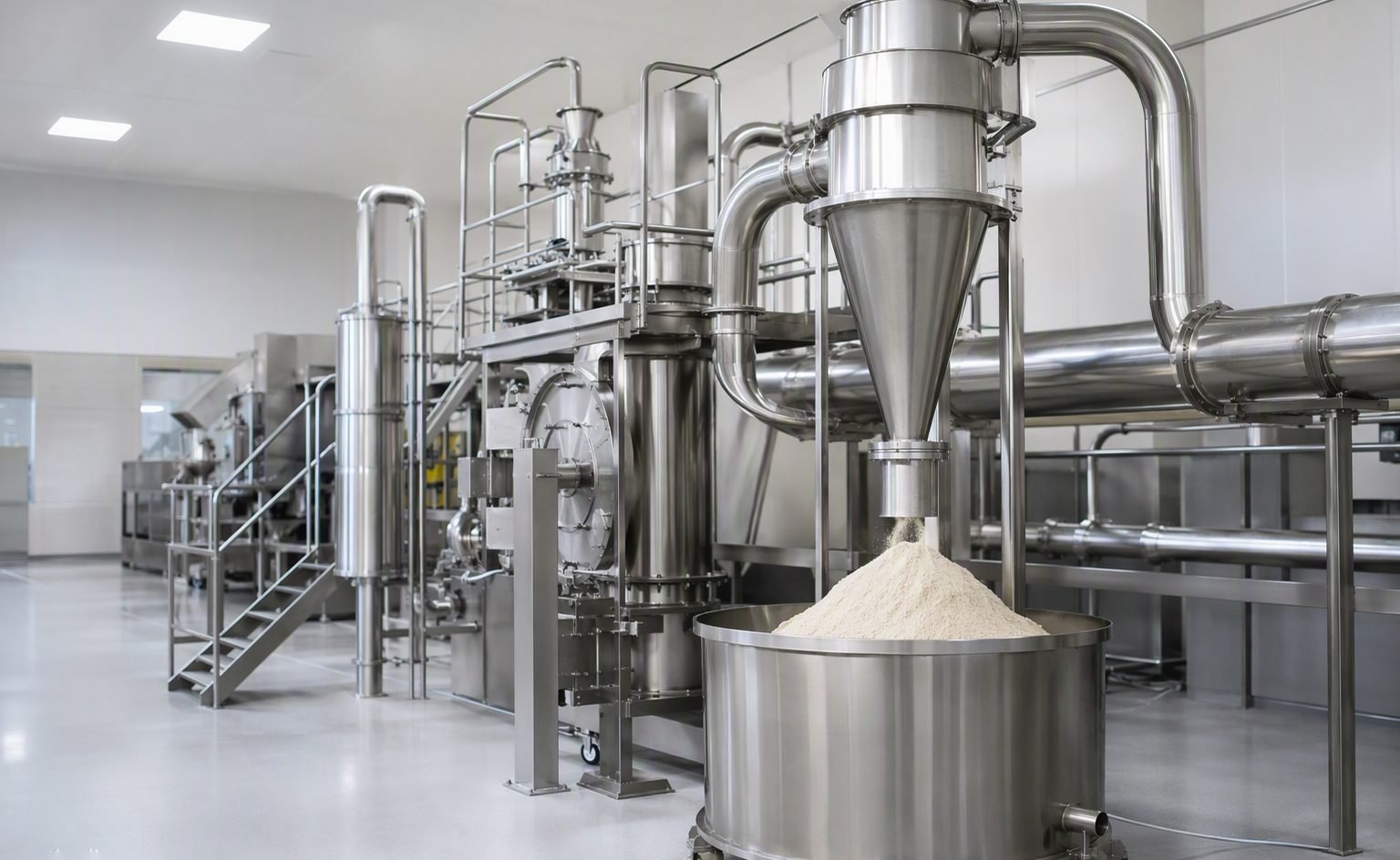
New to the ingredient itself? Start with what is egg powder? — the definition, the three types and where each is used — then return here for the process detail.
Read this first: general process vs verified process
Two kinds of statements appear below, and the difference matters. General industry process describes how egg powder is made across the industry — useful for understanding the product, but not a description of any specific factory. Sahya Agro verified process describes our own line — and where a detail has not been confirmed in writing, we mark it [PROCESS DETAIL TO BE CONFIRMED] rather than guessing. Ask us, and ask every supplier you evaluate, to put their specific answers in writing.
Step 1 — Egg sourcing
Industrial egg powder begins with shell eggs sourced for processing — in Sahya Agro's case, from within our integrated egg operation. Across the industry, sourcing models range from fully integrated farms to open-market procurement; what matters to a buyer is whether the supplier can trace eggs to source and document it. Our traceability model is described at Quality — Traceability; sourcing specifics: [TRACEABILITY DETAIL TO BE CONFIRMED].
Step 2 — Handling and breaking
Eggs are received, held under appropriate conditions, and broken by machine at industrial scale, with shell and liquid streams separated. Hygienic breaking matters because everything downstream inherits the microbiological state of this step — one reason buyers should ask suppliers how breaking-area hygiene is controlled. General industry practice; Sahya Agro line details: [PROCESS DETAIL TO BE CONFIRMED].
Step 3 — Separation (where applicable)
For whole egg powder the liquid streams stay combined; for egg white or egg yolk powder, whites and yolks are separated at breaking. Separation efficiency affects the composition of both fractions — a parameter serious suppliers monitor, because traces of yolk fat in albumen degrade whipping performance.
Step 4 — Filtration and processing
The liquid egg is filtered to remove shell fragments and membranes, and may receive further processing depending on the product: homogenisation for uniformity, and for albumen commonly a desugaring step (removing glucose) to protect storage stability and browning behaviour. Which processing applies to which product is a specification-level question — ask it explicitly.
Step 5 — Pasteurisation
Liquid egg is pasteurised before drying — a defining food-safety control in egg product manufacture. Pasteurisation conditions are product-specific and regulated in most markets; we do not state temperatures or holding times for our line without verification: [PROCESS DETAIL TO BE CONFIRMED]. What buyers should ask any supplier: is pasteurisation applied, how is it validated, and how is it documented per batch. See Quality — Food Safety for our controls framework.
Step 6 — Drying
Spray drying is the industry's dominant method: the pasteurised liquid is atomised into a hot-air chamber, where droplets dry into powder within seconds and are separated from the air stream. Drying parameters shape the powder's moisture, solubility and functional performance — which is why we publish no exact figures without verification: [PROCESS DETAIL TO BE CONFIRMED]. Other methods exist in the industry (for example, freeze drying for niche applications), but spray drying defines mainstream egg powder.
Step 7 — Powder handling
Dried powder is conveyed, cooled and held for packaging under controlled conditions. Powder is hygroscopic — moisture exposure at this stage degrades solubility and function — so handling-area conditions are a legitimate buyer question for any manufacturer.
Step 8 — Testing
Batches are tested against the specification before release: the results become the certificate of analysis that accompanies delivery. Testing scope and where tests are performed (in-house versus external laboratory) are buyer questions; our categories and documentation approach: Quality — Testing and Quality — COA.
Step 9 — Packaging
Powder is packed into moisture-barrier formats with batch identification that ties pack, COA and shipping documents together. Formats: [PACKAGING FORMAT TO BE CONFIRMED]; the packaging guide covers what packaging must achieve.
Step 10 — Shipment
Released batches ship ambient, with the document chain appropriate to the destination — see Quality — Packaging & Storage and the import-export guide.
What to ask any manufacturer about their process
- Which steps are performed on your own line, and which (if any) are outsourced?
- Is pasteurisation applied to all products, and how is it validated and recorded?
- What drying method do you use, and which parameters do you control for consistency?
- Is albumen desugared, and how does that appear on the specification?
- Which tests are run per batch, in-house or external, and where do results appear on the COA?
- How does batch identity flow from egg source through to my delivery?
A manufacturer who answers these in writing — with placeholders where something is unconfirmed — is easier to qualify than one who answers everything smoothly.
Practical takeaways
- Understand the arc. Break → separate → process → pasteurise → dry → test → pack: every quality attribute has a step where it is made or lost.
- Pasteurisation is the pivot. It is the defining safety control; ask how it is validated and documented, not just whether it exists.
- Drying sets the function. Spray-drying parameters shape moisture, solubility and performance — a consistency question for your supplier.
- General ≠ verified. This guide's industry description is orientation; Sahya-specific details carry [PROCESS DETAIL TO BE CONFIRMED] until documented.
Answers
Process FAQ
Eggs are broken and homogenised, separated where a single fraction is wanted, filtered, pasteurised, then dried — usually spray dried — into powder, which is handled, tested, packaged and shipped under batch control. This is the general industry process; manufacturer-specific details should always be confirmed in writing.
Pasteurisation of liquid egg before drying is standard industry practice and a defining safety control. For Sahya Agro's specific pasteurisation validation and documentation: [PROCESS DETAIL TO BE CONFIRMED] — ask us, and ask every supplier, to confirm in writing.
The dominant egg-powder method: pasteurised liquid egg is atomised into a hot-air chamber, dries into powder within seconds, and is separated from the air stream. Drying parameters shape moisture, solubility and functional performance.
Yes: the fractions are separated at breaking, and albumen commonly undergoes desugaring (glucose removal) to protect storage stability and browning behaviour. Which processing applies should be visible on the product specification.
Properly controlled drying preserves the functional proteins that make egg useful — whipping, gelling, emulsifying. Functionality is application- and process-specific, which is why buyers validate samples in their own process rather than relying on general claims.
We do not publish unverified temperatures, times or moisture targets — such values appear as [PROCESS DETAIL TO BE CONFIRMED] until confirmed. Buyers evaluating us receive process and control documentation through the qualification process.
From within our integrated egg operation, with traceability described in the Quality section. Specific sourcing and traceability details: [TRACEABILITY DETAIL TO BE CONFIRMED].
Batches are tested against the specification before release, with results reported on the batch COA. Testing categories and documentation are described in the Quality section; ask any supplier which tests are in-house versus external.
Egg powder is dried egg — the ingredient list reads as egg. Whether it fits a specific label claim is a regulatory and marketing decision for your market, not something any manufacturer can decide for you.
Work with us
Ask us the hard questions.
Process, pasteurisation validation, testing scope — we answer in writing during qualification.